$535,100 in FY2022 → $754,100 in FY2026
The question this Atlas answers
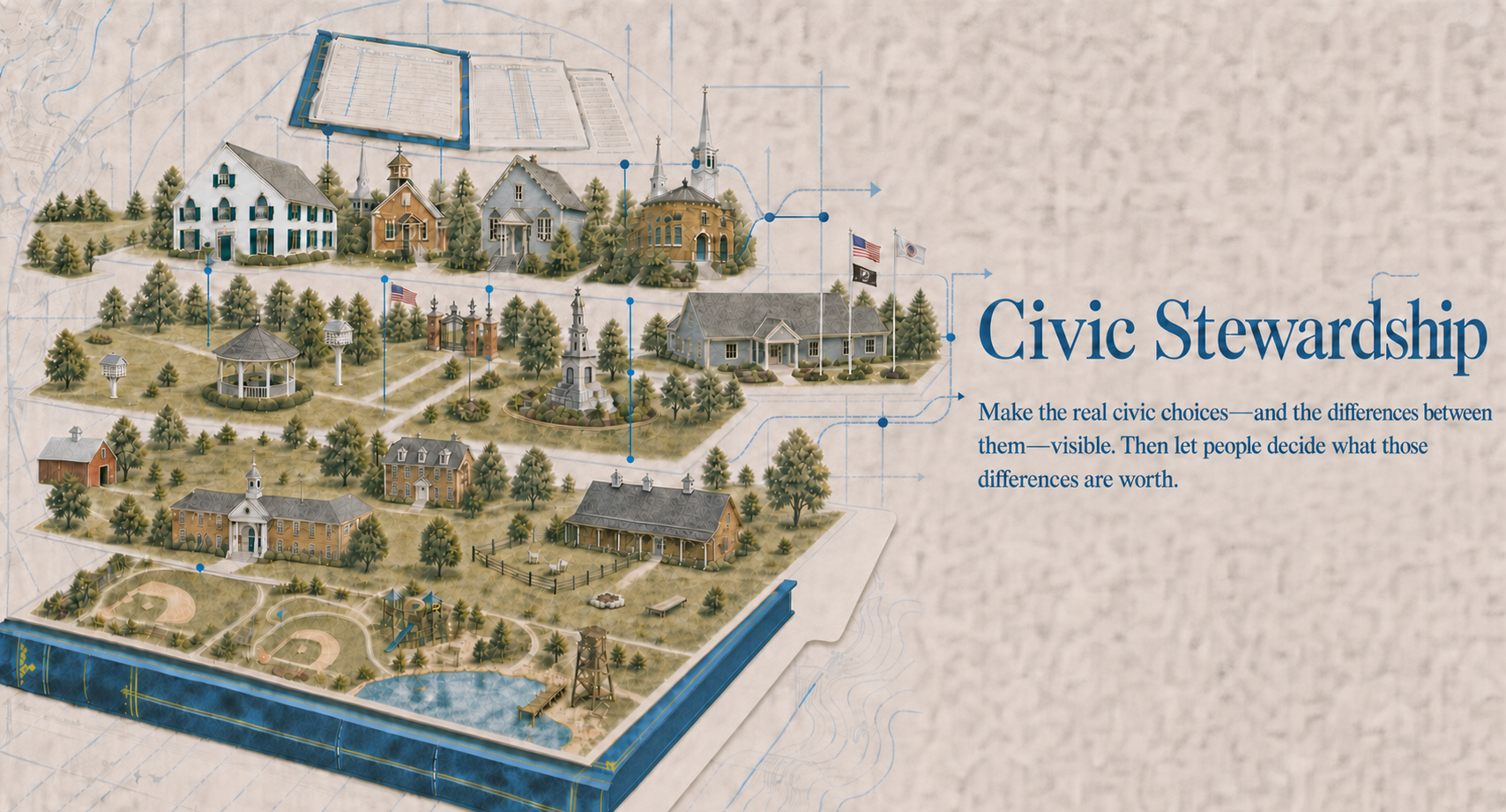
Make the real civic choices—and the differences between them—visible. Then let people decide what those differences are worth.
CivicSS began with one Wilbraham project and a resident trying to understand what was happening. The public information existed. The usable understanding did not. Following that question through money, buildings, roles, plans, evidence and community values exposed a larger problem: no single place showed how all the parts connected.
The system grew from that search. CivicSS is the connected civic decision system; CSKE is the knowledge environment beneath it. This Atlas is the dated, front-to-back documentation of what they contain, why each layer became necessary, how the parts work together, what supports them, and what remained unfinished on August 25, 2026—before Sherie joined the Finance Committee.
↗ opens another page+ expands here➜ follows the story
How one question became a system
Public information is not the same as usable understanding.
Somewhere along the way, the question stopped being about one project. It became a question about how an entire Town works—and whether scattered evidence could be connected well enough for people to see the real choice together.
- 01
One project raised a question
What was being proposed, what problem would it solve, and what evidence and process were carrying the choice?
- 02
The information was public—but scattered
Meetings, budgets, maps, studies, plans, financial records and annual reports existed in different places and at different levels of detail.
- 03
One question became the whole Town
Understanding the project required understanding roles, money, work, assets, services, prior promises, legal limits, place and community values together.
- 04
The relationships outgrew one workbook
Scenario models revealed how much evidence had to remain connected across sources, time, entities, assumptions and alternatives. That need led to the structured data and knowledge layers.
- 05
Connected data required controls
A stored value is not automatically a trustworthy fact. Sources, provenance, loading, human verification, acceptance and reporting eligibility had to remain visibly separate.
- 06
The same evidence needed different depths
Residents, staff, specialists and decision makers should not receive competing facts. They need a shared evidence base explained at the depth each question requires.
- 07
The real decision returned to people
Once false choices and material unknowns are exposed, CivicSS shows what viable paths cost, risk, preserve, change or give up. It does not decide what those differences are worth.
The Atlas documents this progression. The personal story explains why the system exists; the governed sources, controls and dated artifacts establish what can responsibly be claimed about it.
The resident aha
“I knew my assessment had gone up. But what actually changed—and how did my property compare?”
Start with one property a resident knows well. Remove the address. Keep the question, the comparison and the evidence boundary.
$319,400 in FY2022 → $429,500 in FY2026
And then the real question appeared: why?
Sherie knew she had not added a building improvement. The available system history showed the different assessment path, but it could not yet verify a complete permit and property-change history or explain the cause. That does not make the comparison meaningless—and it does not prove the assessment was right or wrong. It tells us what evidence to connect next: property changes, market segment, neighborhood, data corrections, valuation method and the official local record.
That is what CivicSS adds. A personal “something changed” becomes a precise, bounded question that can lead into Assessors, affordability, Town finances, budget choices and the larger decisions residents are being asked to carry.
See how My Property Story worksEvidence and limits: anonymized source-layered My Property Story example prepared August 29, 2026; FY2022 and FY2026 assessed dollars and percent change from standardized MassGIS assessment extracts; comparison to the Wilbraham single-family median for the same fiscal years. The report was an undeployed prototype. The available local GIS/CAMA and permit history was incomplete, so “no known building improvement” is Sherie's resident knowledge—not a conclusion established by the current data. Assessment is not an official bill, appraisal judgment or finding of correctness.
See the difference
The same choice looks different when its relationships become visible.
The system does not decide for Wilbraham. It replaces an isolated question with the fuller question people actually need to answer.
Without the connected systemWith the connected system
“Should we approve this project?”What problem are we solving, which alternatives are genuinely viable, and what does each require?
A project costAcquisition, construction, financing, operation, maintenance, replacement, and lost flexibility
A building or parcelAn asset connected to services, people, place, condition, history, and future obligations
A recommendationA conclusion connected to evidence, assumptions, uncertainty, and unresolved questions
Preservation versus progressThe real difference in cost and risk, compared with what each alternative preserves, changes, or gives up
A final voteA traceable rationale that can later be compared with what actually happened
One Wilbraham example
The BUC question is not simply “save the building” or “move forward.”
After access, legal, operational, ownership, financing, and implementation questions are resolved, the real choice becomes visible: what is the difference in cost, risk, control, service, flexibility, and sense of place between the viable alternatives—and what is that difference worth to Wilbraham?
Follow this decision front to backHow it works
Carry the choice as far as evidence can take it. Mark where human judgment begins.
- 01Start with purpose
Recover what Wilbraham has repeatedly said matters.
- 02Connect the whole
Link work, assets, spending, obligations, place, history, and people.
- 03Test the evidence
Separate known, estimated, missing, contradicted, and unresolved.
- 04Remove false choices
Apply legal, access, operational, ownership, financial, and readiness gates.
- 05Compare what remains
Show cost, risk, service, control, flexibility, and consequences on the same basis.
- 06Return the decision
People judge what each viable path is worth—and later compare the result with the rationale.
Open the complete front-to-back system path
- 01
See what Wilbraham values
Make strategy and identity explicit before evaluating a project.
- 02
See the work already underway
Connect objectives to roles, programs, projects, and follow-up.
- 03
See what the Town must sustain
Move from requests to assets, services, obligations, and future costs.
- 04
See the evidence and its limits
Trace claims through governed data, sources, missingness, and validation.
- 05
Compare real alternatives
Remove false choices and expose comparable cost, risk, and consequences.
- 06
Make the human decision
Decide what the difference is worth—and what Wilbraham wants to preserve.
Choose your path
Where do you want to begin?
You do not have to read eighteen chapters in order.
01
Understand the system
Start with the human learning path
See how an observation becomes a question, evidence, a shared understanding, and a better next decision.
Open this path02Follow one decision
Watch the parts work together
Use the BUC and Senior Center question to follow one Wilbraham choice from purpose through scenarios and judgment.
Open this path03Verify the dated evidence
See what existed—and when
Enter the pre-Finance-Committee Evidence Room, with its private/shareable boundary and counsel-reading path.
Open this pathWhat the platform makes possible
Connect what a real civic decision cannot afford to separate
The Atlas is not a catalog of tools. It shows how each capability closes a gap that used to be left for one person to remember, reconcile, and explain.
- Strategy to budgets
- Judge a spending request against the mission, objectives, measures, and prior promises it is meant to advance.
- Capital requests to a complete asset inventory
- See the building, land, system, service purpose, condition, maintenance history, and future obligation behind the request.
- Current spending to future obligations
- Show what today's choice adds to maintenance, replacement, staffing, debt, services, and the amount residents may later have to carry.
- Recommendations to supporting evidence
- Keep the path from a recommendation to its source, assumptions, exclusions, current status, and what it does not prove.
- Missing information to explicit follow-up
- Turn unanswered questions into visible, owned work instead of allowing a blank to become false certainty—or zero.
- Technical financial material to explanations residents can use
- Answer the human question first, then open the calculations, limitations, sources, and governed data for readers who need more.
All reports
Choose the question you need
Each chapter gives the short answer first, then opens the relationships, limits, and evidence underneath it.
010203040506070809101112131415161718
Evolving practice
Civic Stewardship & Decision Science
What is Civic Stewardship—and why does a community need a decision science before it needs another answer?
Demonstrated method
Understanding Together
Before communities decide together, how do they learn to understand together?
Evolving practice
Participation & safe civic applications
How can residents help Wilbraham understand a decision without turning every observation into an official fact—or every useful digital tool into an official Town system?
Working foundation
Wilbraham’s values & choices
Wilbraham makes many reasonable decisions through different parts of government—but where can residents see whether those choices are adding up to the community Wilbraham says it wants to be?
Evolving practice
Roles & operating control
How does a Town idea become a real obligation—and who is allowed to move it forward?
Working foundation
Portfolio of work
How can Wilbraham see everything it is already running and changing before one more decision is added?
Working foundation
Assets & capital
What are residents already responsible for keeping working—not just buying next?
Accepted reporting source
Town money, funding & grants
When Wilbraham identifies a grant or funding source, what does that actually mean—and what still has to happen before residents receive the promised result?
Accepted reporting source
Evidence engine
How can many public records become one traceable body of evidence?
Evolving practice
Quality & human verification
What does it take before a stored value is safe to use?
Accepted reporting source
Queries & governed access
How do we ask the evidence a precise question?
Demonstrated method
Whole-picture reporting
How does technical evidence become something a resident can use?
Working foundation
Services, portability & decommissioning
If a service provider changed tomorrow, what must survive?
Demonstrated method
Scenarios & decisions
Where does the real civic choice finally begin?
Evolving practice
Place, identity & townwide balance
What can a technically valid choice still fail to see?
Demonstrated method
One decision, front to back
What does the whole system do for one real decision?
Evolving practice
Maturity & road ahead
What is real today—and what still has to be built?
Working foundation
Evidence room
What is here, what is shareable, and what remains private?
MAGIC² · where the human decision begins
The first magic makes the responsible paths visible. The second makes the real choice between them visible.
Legal, regulatory, operational and financial work removes false choices and exposes unavoidable risks. When more than one responsible path remains, the real civic decision begins: affordability or service, growth or character, efficiency or continuity, preserving a place people love or making room for something new. The magic is not that CivicSS chooses for us. It lets us see what we are choosing, what each path asks us to protect or surrender, and why people care so deeply.
A model can compare evidence, assumptions, readiness, cost, risk and consequences. It cannot determine a community's values, replace professional judgment, create lawful authority or certify an answer.
This Atlasdocuments the complete CivicSS/CSKE system and its dated evidence.
Whole Pictureexplains the broad, connected story of Wilbraham.
Capital Managementfollows capital plans toward certified action, financing, execution, completion and later stewardship—showing where evidence still stops.